Friday, 13 June 2014

A glimpse at the magic qualities of authentic Irish Crystal


Ireland has always boasted a long and illustrious history of craftsmanship in glass and crystal making. The origins of this great craftsmanship can be traced back to the early Celts who put their artistic talents to good use by integrating the pure white sands from the shore's of Ireland to produce beautiful glass beads and Celtic jewelry.  Over the passage of time, Ireland’s skilled craftsmen spawned a thriving hand-blown lead crystal industry throughout the country, which is still renowned across the world due to its quality and distinctive Celtic splendour.

Authentic Waterford CrystalTwo of the more recognised manufacturers of Irish Crystal are Waterford and Galway Crystal. Waterford Crystal was established in the southern Irish town of Waterford in the late 18th Century.  The manufacturers in Waterford introduced stylish and intricate designs and patterns to its stemware that soon became synonymous across the globe for its exquisite crystal glasses and crystal gifts.

Irish Crystal at its very best, the Waterford Crystal Collection is known for its quality and beautiful glassware such as crystal wine glasses and waterford crystal decanters. The range of products  as well as its home accessories such as Waterford Crystal vases, crystal clocks and crystal picture frames.

Our collections include Lismore (the most famous of the Waterford Crystal patterns), Marquis, Fleurology, Colleen, Clarendon, Irish Lace and Pineapple.

There is always something mystic and magical about authentic Irish Crystal. Whatever design or piece you may be looking for, a piece from any of the Waterford Crystal collections makes the ideal traditional Irish gift and is a well-received Irish wedding gift that will be treasured forever.

Friday, 16 May 2014

The rich cultural history of Celtic Jewelry

It was around 500 B.C. that the Celtic cultural revolution took hold with the Celtic language and culture becoming prominent. The cultural style was very much influenced by La Tène, after an area of Switzerland where artifacts reflecting La Tène style were first found. La Tène artwork is commonly defined by curves and spirals; with geometric or abstract symbols, such as the triple spiral design, being prominent ornamentation.

Due to their intricate craftsmanship, many of these metal Celtic jewelry pieces have been discovered in good condition from that time period. A familiar item that has often been found is the Torc which are believed to be a symbol of status. Since Celtic jewelry is both decorative and made of precious metals, most jewelry discovered in the various archaeological sites throughout Ireland is considered to be decorative rather than practical.

It was also around the same time period that Celtic culture found its way into Ireland, the Irish Iron Age took hold, combining the new Celtic culture with the old Irish culture. While iron was used for tools, jewelry and other pieces were made from the visually exquisite and long-lasting bronze and gold.

Around 600 A.D., Christianity began to surface in Ireland. Religious beliefs mixed with Celtic and Irish art, producing a new style known as Insular art. Insular Art is famous for its illuminated manuscripts, the Book of Kells being the more renowned example. Insular art maintained the geometric, interlaced style that was present in La Tène art.

Celtic Wedding Bands from Blarney.com
Many brooches were made during this time period. The Tara Brooch is particularly impressive, made of silver-gilt and decorated with filigree and interlace design. This style is repeated throughout Celtic jewelry. Irish metalworkers also created the Ardagh Chalice around this time, and it remains one of the most impressive Celtic creations, intricately decorated with the interlace typical of Celtic Irish art. While jewelry remained a status symbol, it was often infused with Christian elements, such as the apostles' names on the Ardagh Chalice, giving special prestige and meaning to some pieces.

Another offshoot of the Christian influence was the proliferation of Celtic crosses, which were particularly common around the ninth century. The Cross of Cong is an example of the excellent goldsmithing skills of Celtic artists. The Cross of Cong had high religious value when it was created, as it was initially made to hold a piece of the cross the Irish believed Christ was crucified on.

Celtic influence is still very strong in Irish jewelry today and is often a a great idea for Irish gifts and particularly traditional Irish gifts. The iconic Celtic Cross is a common theme, though historians and researchers can only speculate upon the meaning of the ring at the intersection. Celtic knot jewelry are also a familiar symbol, used today to honour Irish and Celtic jewelry tradition. Through modern Celtic jewelry, the masterful metalworkers of the past live on, in particular, Celtic rings and Celtic wedding bands.

Friday, 25 April 2014

The mystic of the Trinity Knot in Celtic Jewelry

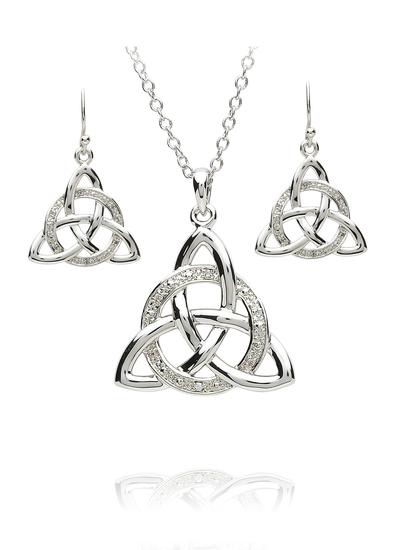
As a familiar symbol of celtic and Irish jewelry, the Triquetra (also known as the Trinity Knot) originally referred to a "triangle" shape and was commonly used in reference to a range of three-cornered shapes. 

More recently,, it has come to exclusively signify a particular more complex shape which is formed of three vesicae piscis, which is often complimented by an additional circle in or surrounding the symbol. Within the realm of Celtic knot jewelry the symbol is more commonly known as the "trinity knot," and the design often utilized as a religious symbol by both those of the Christian faith and polytheists.

The Trinity Knot can often be spotted on various forms of Insular celtic artwork, especially on pieces of  celtic metal work and in illuminated manuscripts such as the much loved Book of Kells. 

Early Christian artwork such as celtic crosses and slabs often bear the Trinity Knot symbol. The symbol was rarely used as a standalone piece within the medieval celtic artwork and was often integrated in with other design elements.

Over the last century, the symbol has seen a revival in Celtic art and the knot has been recognized as singular symbol that has been used as a sign of special things and persons as a triumvirate. At Blarney Woollen Mills, our extensive range of celtic knot jewelry includes many celtic earrings and celtic pendants which are beautifully ornamented with the Trinity Knot symbol and can often make ideal Irish gifts.

Friday, 11 April 2014

The significance of the Celtic Pendant

Celtic Jewelry can be traced back to a very distant past roughly during the period bwteen 2000 BC and 550 AD when silver and gold was used by Celtic craftsmen to create exceptional pieces of jewelry decorated with a variety of Celtic symbols. Celtic pendants were one of the earliest types of bodily adornment to be crafted by these ancient civilizations.

The word pendant orignates from the French word "pendre" and also the Latin "pendere" which translates as "to hang down". Pendants are a loose-hanging piece of jewelry which tend to be attached to a necklace by a small loop. This piece of Celtic jewelry can also be referred to as a "pendant necklace".

Celtic Pendants from Blarney.com
Pendants as pieces of Celtic jewelry can serve a variety of functions, which can also be combined:
  • Award ( for example the Order of CúChulainn)
  • Identification
  • Ornamentation
  • Ostentation
  • Protection
  • Self-affirmation
There are a multitude of specialized variations of pendants in use today including lockets which open and pendilia, which hang from larger objects of metalwork.

There is a wide range of Celtic pendants available from Blarney.com making the perfect Irish gifts and also a great piece of jewelry to accentuate any outfit. These pendants are expertly handcrafted from Sterling Silver or gold or even traditional Irish bog oak.

As ornate pieces of Celtic jewelry, they evoke the rich and varied history of the anicent Celtic world by utlising the various symbols of that period such as Celtic crosses, shamrocks, trinity knots, claddaghs, trinities and such. The Blarney collection is populated with a variety of works by Ireland's finest Celtic jewellers.

Friday, 28 March 2014

The rich and varied history of Irish Belleek

A piece of Belleek is often a great Irish gift idea Mother's Day and these hand-crafted Fine Parian China represents over 156 years of craftsmanship and history. Belleek does indeed have a rich history which we'll delve into a little in this week's blog.

Classic Belleek pottery, the oldest craft pottery in Ireland, originates from the picturesque Northern Irish village of Belleek in County and universally recognised and loved by millions from across the globe. Irish Belleek has been crafted on the banks of Lough Erne by Belleek Pottery since 1857 and is also home to the world renowned Belleek Fine Parian China and immensely popular Belleek Visitor Centre.

Belleek Pottery was the brainchild of three men - John Caldwell Bloomfield, Robert Williams Armstrong and David McBirney. Bloomfield was eager to create a porcelain factory and so provided the land on which Armstrong design and built the factory that still stands today, all of which was financed by McBirney. The final structure was purposely designed to resemble a large country manor and was finally completed in 1860 at which stage earthenware was already in production.

Initially the factory focused on producing earthenware which  included high-quality domestic ware, floor tile, hospital sanitation ware and Belleek Building telephone insulators. However, after a number of years and some failed attempts at producing fine porcelain, it was agreed to bring on board a number of skilled artisans which heralded the birth of Belleek Parian China.

The reputation of the Belleek fine porcelain soon spread and its status was confirmed after it received commissions from various luminaries including Queen Victoria, the Prince of Wales and members of the nobility. The knock on effect of this new found status was increased demand in the United States, Australia and India.

Belleek production flourished until the onset of World War 1 and with a dwindling order book and skeleton staff levels it was sold to an Irish business man from Dundalk and renamed the Belleek Pottery Limited. Once again Europe was gripped by war with the onset of World War 2 and so the factory reverted to producing earthenware once again do to the lower production costs and saw the factory survive this barren economic  period. Following the war demand grew once again and fine Irish Belleek and Belleek gifts were in produced in great quantities.

Each piece of fine parian china, is a truly original piece of Irish Craftsmanship, made using materials and techniques handed down through generations. No two pieces are ever the same. Every handle, flower and brush stroke is skilfully applied by hand to create the look and feel that is uniquely Irish Belleek and makes ideal traditional Irish gifts for those special occasions.

Friday, 21 March 2014

The Book of Kells - A source of inspiration for Celtic Jewelry

The "Book of Kells" is a group of manuscripts created in approximately the 9th century A.D. in Ireland and the northern region of the British Isles. The manuscript is renowned throughout the world for its extraordinary collection of pictures, interlaced shapes and ornamental details.

The document is effectively a transcript of the four Gospels transcribed in Latin along with The Lindisfarne Gospels, and the amazing lettering and illumination are the creation of Irish monks. It is a remarkable example of early western art and the finest surviving illuminated manuscripts in the whole of Europe.

Each of the transcript's pages often depicts a strange, half-Surrealist imagination thanks to a skilled technique and the very fine state of preservation make it an object of endless fascination. It possesses colorful and complex decoration that would take a life-time to properly study it. The designs are very complex and ornate. They consist of strange little animals, plants, spirals, mazes, and swirls. Only two of its 680 pages do not have any decoration. The almost unbelievable minuteness of the details, the arabesque, interlaced patterns, the weird and witty monsters and grotesqueness are still a source of inspiration to modern artists who create Celtic jewelry such as Claddagh rings and Celtic rings.

Certainly, examples as in the Book of Kells present such a significant and unselfconscious blurring of the dividing line between the Christian world and the slowly fading pagan world.

The book consists of a Latin text of the four gospels: Matthew, Mark, Luke and John. It also contains the canon-tables, the breves causae (summaries of the gospel), argumenta (strange collections of lore and legend concerning the evangelist), lists of Hebrew names with interpretations and genealogy in the Gospel of St. Matthew.

The book is incomplete. It is missing several pages either from getting loose or forcibly removed. It is a large-sized book which shows that it was probably intended to be an altar-book. The book does not have any gold decoration but a generous use of yellow makes up for the lack of gold. Some other colors in the book are red, black, purple and indigo. Decorated initials are a very common feature of the book. Many of the letters fit into the shape of animals. Some examples of animals are: lion, calf, eagle, snake, moths, otters, cats and mice. The designs in the book have an almost perfect symmetry.

The books are bound and sewn by hand, following a medieval process that requires great skill. What do we know about the artists and craftsmen who made this book, almost 1200 years ago? Not very much. No records have come down to us. There is no list of credits, not even an account book. There are some visual clues, however. Experts who have studied the manuscripts have been able to identify only four "hands" in the calligraphy.

The manuscript was held at Kells until 1661 when it was moved to Dublin where it remains as the chief treasure of Trinity College Library.

Friday, 14 March 2014

Get into the holiday fun spirit in irish themed style for St Patrick’s Day

In the month of March when it comes to gift giving there are two main occasions to note, one being mothers day and the other a not so traditional gift giving occasion but one where sometimes Irish gifts are part of a fun occasion: St Patrick's Day.
Novelty Irish Gifts for St Patrick's Day
First off the mark on the holiday gift giving front is Ireland's national holiday and the day the whole world goes green (literally) St Patrick's Day. When it comes to gift giving occasions St Patrick's day wouldn't feature on many peoples lists but nowadays it is the perfect opportunity to get into the spirit of things and spoil oneself or treat ones family and friends to all manner of Irish themed gifts, from traditional Irish gifts as well as fun novelty St Patrick's related items. Amid the celebrations of all things Ireland related both of the traditional (sprigs of shamrock) and non traditional kind (green everything, leprechaun hats and shamrock themed prints and novelty items) you will find a large range of Irish themed gift options from the traditional to the ridiculous and fun.
For many St Patrick's Day can encompass two things, one the celebratory fun aspects of the days parades and all day and night celebrations. For others it is a chance to quietly remember our heritage and traditions and mark it by spending time with our family both at home and abroad. This family friendly and heritage rich national holiday with its fun festival atmosphere can be celebrated and noted in many different ways and most importantly styles with an Irish theme in mind.
St Patrick's Day Irish gifts
With the many parades held nationwide in Ireland and in major cities worldwide celebrating all aspects of Irish culture, St Patrick's Day is a day where people celebrate and throw caution to the wind when it comes to wearing their colors on their sleeve. Fashion-wise it is a day for all things Ireland related and what you wear and how you show your Irish colors and roots can be a key aspect. St Patrick's Day can be an occasion where you indulge in all manner of Irish related style in all manner of tastes. You can don the colors of the day and occasion with all manner of green, shamrock and Ireland related festive outerwear for a day at the parades. From green face paint and every items of clothing imaginable to leprechaun hats, to shamrock headbands and themed prints to customized novelty t-shirts that note the fun and Irish centered aspect of the day, everything green and Ireland related no matter the taste is welcome.
And one doesn't have to go all out with the green body paint and novelty hats and t-shirts and questionable style and taste to note the day either. You can show your Irish roots and affiliations with style too, with a simple piece of Celtic jewelry, a specially customized St Patrick's day charm/bead bracelet, an ornate Irish Celtic designed scarf adorning your natural look. Or you can mark it in the traditional way with your favorite piece of Irish clothing such as Aran sweaters or cardigans, a tweed hat or scarf etc adorned with a sprig of shamrock or clover.
Whatever way you mark the occasion and show your Irish colors be it loud and proud or more demure and traditional there are many Irish themed gift items to help you get into the heart of all things St Patrick's Day related. From picking the right items of clothing for the big parades and parties on the day to showing your Irish roots whilst still keeping in touch with your own style you will find Irish themed items to suit.

Friday, 21 February 2014

The Aran Sweater: a garment full of history and tradition

The Aran Sweater (or geansaí in Irish) is a type of jumper synonymous with the rugged rural lifestyle of the west of Ireland and takes its name from the Aran Islands off the west coast of Galway Bay. These iconic garments are also commonly referred to as Irish fisherman sweaters. Classical Irish Fisherman sweaters are typically a dense bulky item of clothing comprising cable knit patterns on the chest area and tend to be cream in colour.

The Aran Islands are made up of three islands: the smallest of which is Inisheer, followed by Inishmann and then the largest which is Inishmore. Stones are abundant throughout the islands with the trademark stone fences stretching across the landscape in addition to the numerous ruinous stone forts.

Knitting was communal for the wives and daughters of the fisherman as well as a forum for education and storytelling. Their work was usually arduous with a single Aran sweater taking between 40 and 50 hours to complete.

These iconic Aran sweaters are clearly distinguished by the use of complex interwoven textured stitch patterns. Often a combination of these stitch patterns are used in the production of a single sweater. Every stitch pattern has traditional interpretation and a distinctive story:
  • Blackberry - represents the thickets of blackberry bushes which dot the Aran Islands. It is a clear reminder of natures riches.
  • Tree of Life - This depicts the tendrils of family, clans and past generations.
  • Cable - represents the fisherman's ropes and hopes for the day's catch.
  • Diamond - frequently matches with moss stitching. This represents the hope of future wealth and success.
  • Moss - represent the carrageen moss which lines the stone walls of the islands. Often knitted as a diamond filler.
  • Zig Zag - represents half a diamond and depicts the cliffs of the islands.
  • Basket - represents the angular squares of a fisherman's basket and the hope of bountiful baskets of fish to bring back his family.
  • Honeycomb - represents the tireless hard work of the islands' inhabitants. A testament to the busy bees of the island.
  • Trellis - represents the countless fields which make up the island.

Aran Sweaters for men
Traditionally, an Aran jumper is made from undyed cream-coloured (otherwise referred to in Irish as báiní), a yarn made from sheep's wool. They were originally made with unwashed wool that still contained natural sheep lanolin, making the garment extent water-resistant. There are few sheep on the Aran Islands today and more critically even fewer knitters. Modern Aran Sweaters are generally machine knit with soft Merino wool though there is a limited production of hand-knits. Aran sweaters for men, women and children of all ages are now available to be purchased and often a great idea for great Irish gifts.
 
Aran sweaters from the 1930's and 1940's are displayed at the National Museum of Ireland. They are rightly regarded as a national treasure and classic example of the hard working ethic that typified rural life in Ireland during the early 20th century and before it.
 
The patterns, designs and embossed decoration on every Irish wool sweater still reflect the loves, lives, losses and defiance of this isolated community at the edge of the Atlantic Ocean.
 

Friday, 7 February 2014

Some Irish gift ideas for Valentine's Day

January has come and gone and we're into the month of February and that can mean only one thing... men and women around the world turn their thoughts to Valentine’s Day gift ideas for that special other.

Valentine's Day can often be regarded as a cynical chance to cash in on an old tradition but for many it is a time to celebrate a couple's feelings for one another. Each year the 14th February provides the ideal opportunity for couples to infuse a little added romance and spontaneity into their relationship and for this reason you can illustrate your feelings for that special someone in your life whether its your girlfriend, boyfriend, husband or wife and how much they mean to you with a romantic gesture or thoughtful Irish gift

So now its time to consider your Valentine’s Day gift options! Do you decide to opt for a romantically themed traditional gift or, alternatively, for a personalized gift that you know your special other will cherish?!

Then again you may decide that that a traditional romantic gift just wouldn't be his or her's style and would rather celebrate the special occasion with a gesture or action such as a romantic dinner in, a date in an exclusive or niche restaurant or perhaps a romantic picnic under the stars which would inject a refreshing sense of romance and spontaneity into the day. 

When it comes to romantic gift ideas either contemporary or traditional Irish gifts - what should you consider to surprise your special other? Chocolates and sweets? a bouquet of flowers? a cuddly toy? an Irish novelty gift? a specially hand crafted piece of Celtic jewelry? Tickets to an upcoming show or concert? A pre-booked night out at a restaurant? A selection of personal love letters or poems? Or some personalized gifts that you know your special other will really cherish?

When you really think about it... there are so many romantic gift ideas to choose from for Valentine’s Day besides the traditional chocolates and flowers, which are a perfectly good idea. If you want to be different there are many Irish gift options to consider so hopefully we've given you some food for thought! Many in the months and years to come you'll be seeking a truly unique Irish wedding ring for that special other!

Friday, 24 January 2014

Celtic Jewelry: The ancient Ogham alphabet and its origins

Ogham, or referred to in Old Irish as 'Ogam', is an Early Medieval alphabet used primarily to write in the early Irish language between the 4th and 6th centuries and later the Old Irish language between the 6th and 9th centuries. 

It is estimated  that there are roughly 400 surviving orthodox inscriptions on stone monuments throughout Ireland and western Britain. The vast majority of these inscriptions can be found throughout the south of Ireland, in the counties of Kerry, Cork and Waterford. Traces of the Ogham inscriptions have also been discovered in parts of Pembrokeshire in Wales. The vast majority of the inscriptions consist of personal names.

The earliest inscriptions in Ogham date to about the 4th century AD. It has been suggested by scholars that the Ogham language drew inspiration from a number of sources such as the Latin, Elder Futhark, Runic and Greek alphabets.

Theories on how this form of ancient alphabet originated can be categorised into two distinct trains of thought. The first theory is that Ogham was created by ancient Irish scholars or druids as a cryptic alphabet designed purposely so that it would be extremely difficult for those with a knowledge of the Latin alphabet to decipher.

The second theory is that Ogham was devised by the first Christian communities in early Ireland, out of a wish to create a unique alphabet for writing short messages and inscriptions in the Irish language. It is considered that the necessity of such an alphabet was due to the fact that Primitive Irish was regarded an extremely difficult language to transcribe into the Latin alphabet, so the creation of a unique alphabet was addressed.

Legend has it that Ogham was first invented soon after the fall of the Tower of Babel, along with the Gaelic language, by the legendary Scythian king, Fenius Farsa. It is sometimes called the "Celtic Tree Alphabet", based on a high medieval Bríatharogam tradition ascribing names of trees to the individual letters.

This ancient and highly distinctive alphabet adorns many pieces of Celtic jewelry to this day, whether it be Celtic pendants or Celtic earrings. Ogham is often used personalize a piece of Irish jewelry with names usually being translated into the ancient Celtic alphabet.

18 Carat Gold Ogham Pendant

Friday, 10 January 2014

An intorduction to Aran Sweaters for the uninitiated

An intoroduction to Aran Sweaters for the uninitiated
The Aran Sweater is an item of clothing synonymous with the island of Ireland and in particular the islands off the rugged west coast. Aran sweaters are a traditional style of sweater that take their name from the Aran Islands off the west coast of Ireland which are often exposed to the harsh weather systems from the Atlantic Ocean. 
Otherwise known as Irish fisherman sweaters, aran sweaters are distinguished by their use of complex textured stitch patterns, several of which are combined in the creation of a single garment. Originally the sweaters were knitted using unscoured wool that retained its natural oils which ensured that the garments remained water-resistant and wearable during wet Irish conditions. However, today most of the Aran sweaters and Aran Cardigans are knit with a softer yarn called Merino in the natural bainin (bawneen) colour and in other colours reflective of the Irish countryside.
  • The honeycomb is a symbol of the hard-working bee. 
  • The cable is an integral part of the fisherman’s daily life, is said to be a wish for safety and good luck when fishing. 
  • The diamond is a wish of success, wealth and treasure. 
  • The basket stitch represents the fisherman’s basket, a hope for a plentiful catch.
Every sweater is steeped in Irish history and every stitch has a traditional interpretation, often of religious significance, but mostly of life’s experience and journey. There varies symbols include:
Most knitting patterns were never written down just handed down from generation to generation using up to 24 different aran stitches with infinite combinations. We'll be looking further into the different stitches and their meaning over the coming weeks to give you a real sense of what it means to own authentic Irish Sweaters.

Friday, 6 December 2013

Waterford Crystal: The Encapsulation of Style and Craftsmanship

Waterford Crystal is renowned globally for its craftsmanship and stylish elegance. Established in the heart of the Irish town of Waterford, the origins of the crystal production dates as far back as 1783 when George and William Penrose started their business. The crystal manufacturers introduced some of the world’s most stylish and intricate designs and patterns to its stemware, Waterford Crystal is known throughout the world for its exquisite crystal glasses and crystal gifts.

Irish Crystal at its very best, the Waterford Crystal Collection is known for its quality and beautiful glassware such as crystal wine glasses and crystal decanters as well as its home accessories such as crystal vases, crystal clocks and crystal picture frames.

Waterford Crystal Gifts

The collections available at Blarney Woollen Mills include:
  • Lismore (the most famous of the Waterford Crystal patterns), 
  • Marquis, 
  • Fleurology, 
  • Colleen, 
  • Clarendon, 
  • Irish Lace and 
  • Pineapple.
Derived from the Irish, meaning "great ringfort", the Lismore collection was inspired by the gothic architecture of the 800-year-old Lismore Castle in County Waterford, Ireland. For more than 60 years, the Lismore collection has represented the best of what Waterford Crystal has to offer become one of their most loved collections.

Whatever the occasion, a piece from any of the Waterford Crystal collections makes the ideal gift from Ireland and is a well-received Irish wedding gift that will be treasured forever.

Friday, 22 November 2013

Irish Jewelry Inspiration: Meso Bog Oak

The first of its kind in Ireland, Meso is a new and contemporary range of Irish jewelry designed by Helen Conneely. With Celtic Roots in Ballinahown, Athlone, Co. Westmeath, Helen’s designer pieces fuse the new with old to produce the distinctive style and design associated with Meso.

Combing ancient bog wood over 5,600 years old with freshwater pearls, leather, sterling silver, oxidised sterling silver and onyx bead, browse the wonderful pieces from the unique Meso Bog Oak jewelry collection available to buy from Blarney Woollen Mills when searching for that elegant Irish gift.

Irish bog-oak ranges in age from 3,000 to 8,000 years old when, believe it or not, the Irish climate was warmer and drier at that time in our history. Oak trees grew profusely throughout the island of Ireland.

Once the island's climate changed to a wetter and damper era, the roots of great oak forests lost their grip in the soggy soil and fell to the ground. Vegetation gradually covered these fallen trees. The tanic acid in the oak trees interacted with the decaying vegetation turning the oak black or a darker brown and preserving it for posterity. It is often referred to as black oak.

This decaying vegetation forms today's bogs. As the turf is cut the ancient oak is uncovered where it was lain for thousands of years. It is soft and pliable at first but as it is exposed to the air it becomes rock hard. Before the advent of electricity slivers of bog-oak and bog deal were lit to provide light in the little cottages while big beams were used for rafters and mantlepieces.

Bog-oak has been highly valued by wood carvers for centuries. Penal crosses carved out of this wood were sold to Lough Derg pilgrims in the 17th and 18th centuries. Personal jewelry and household ornaments were manufactured from this beautiful wood.

What makes bog oak so distinctive is its blackness, hardness, age and mystery and these unique features make it the perfect traditional Irish gift idea.

Friday, 15 November 2013

Great Irish gift ideas this Christmas

It may feel like we've just got over our Halloween celebrations but many of us are realizing that we have just over five weeks until Christmas! There isn't any need to panic just yet but it's a good time to start thinking about some great Irish gifts for your family and loved ones or perhaps novelty Irish gifts for your house-mate or even a work colleague... it is the season for giving after all!

To help you decide, the team at Blarney.com have gone through some of the more popular products over the previous 12 months from our vast range of gifts from Ireland including the ever popular Aran sweaters and Irish jewelry.
  • Celtic Aran Hoodie - This mash of contemporary and traditional has proved to be a real hit with customers.
  • Belleek Set of Four Mini Vases - This would be a great gift idea for those working to a tight budget this Christmas.
  • Ladies Aran Lumber - A classic and elegant piece that is sure to keep you warm on those chilly winter days.
  • Personalized Irish Pub Ornament - This personalized Irish gift is fun and it's got your name on it and you get some turf.
  • Diamond Stitch Aran Throw - A staple for those chilly days.
  • Aran Snood - This beauty made with Merino wool, and Aran stitches such as cable, diamond and honeycombs. One size makes it the perfect gift.
  • Shamrock Wool Aran Throw - It's a staple which sells during the cold winter months with one size great for gifts..
  • Sterling Silver Ogham Pendant - Boasting a simple yet elegant design, this celtic pendant appealed to customers because of its uniquely Celtic look and feel as well as the ability for it to be personalized.
  • Shamrock Pendant - The Shamrock is the classic Irish symbol and synonymous with all things to do with the Emerald Isle. It has proved popular both in our shop in Blarney as well as online at Blarney.com. Shamrock Pendant is the perfect Irish gift and nearly makes it to number one.
  • Muckross Button Aran Cardigan - This has always been a firm favorite best seller. Boasting 100% Soft Merino wool with cable and diamond stitches and coming in six different colours, this sweater is a twist on the traditional Aran sweater for women.

We hope some of these traditional Irish gift ideas can help make the decision process a little easier as the countdown the festive period begins in earnest!

Friday, 8 November 2013

Gift of Irish Belleek this Christmas

Belleek, which is the oldest craft pottery in Ireland and has been handcrafted here for over 150 years, is adored by people throughout the world, and each original piece is reflection of true Irish craftsmanship. Irish Belleek China is produced using only the finest materials and specialist techniques that have been handed down through generations and no two pieces are ever the same.

So as Christmas fast approaches and we all begin to think about purchasing Christmas gifts and keepsakes, we thought we would turn our attentions to the wonderful festive pieces that have been produced by those clever Irish Belleek Potters

This year to adorn our trees, Belleek have created a range of Beautiful Christmas Ornaments including Classic nativity characters, quirky winter snowmen, and traditional Christmas symbols. They have also produced special nativity figures and sets that can be display in windows or on mantels.

Alternatively if looking for special Irish gifts this Christmas, then what about Belleek’s enchanted holly biscuit jar, or their Christmas holiday tea for one pot or perhaps their Christmas hurricane candle holder? All of which is beautifully handcrafted and delicately adorned with embossed festive scenes and Belleek's signature hand painted shamrocks.